


























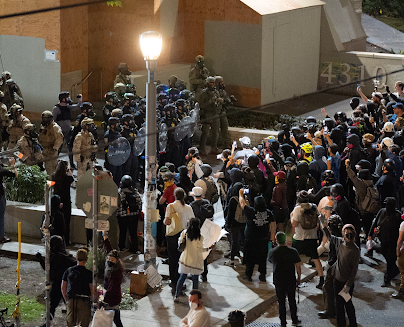
On June 7, 2025, the National Guard was deployed to Los Angeles, CA by the Trump administration “to address the lawlessness that has been allowed to fester.” To show solidarity with those who were protesting the deployment, a protest was planned in Portland, Oregon in front of the Portland Immigration and Customs Enforcement (ICE) facility the same day. This protest sparked many similar movements, not only through the beginning of June, but for months ahead.
Due to the sensitivity of this topic, we will be referring to the two interviewees as Savannah and Moon, respectively. Savannah had spent the month of June attending these protests, going five or six times a week, and Moon, a 20-year-old, has also participated in previous Portland protests.
“On most of the nights I was there, there was this constant push and pull of tension between protesters and the federal agents… The protesters would set up barricades of debris or stand in the driveway with shields in order to barricade the officers inside the facility [we stayed] until the federal agents would come out and rampage through the barricade and the gathered crowds,” Savannah said.
A prominent tactic used in these protests were the inflatable frog costumes, as well as other inflatable costumes.
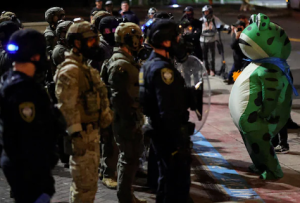
“It feels more difficult to treat people in inflatable costumes violently because I imagine they look less militant and scary, but it is [still easy] to dehumanize a figure, [especially someone whose] face you can’t see,” Moon said.
The federal agents would use chemical munitions such as tear gas, bear mace and pepper balls. They also used military-grade devices such as the Long-Range Acoustic Device (LRAD) during the protests, according to Savannah.
“People won’t stop fighting, but it gets tougher and there are less resources. People are getting burnt out from the constant barrage of violence on all sides,” Moon said.
Most nights, federal officers would be present at these protests. However, during the nights when officers weren’t clearing driveways or carrying out arrests, the protests felt different.
“Some nights had the feeling of a block party, with music and food and mutual aid projects and speeches and just a generally good vibe… It was almost enough to forget that there were immigration agents and federal forces mere feet away,” Savannah said.
Maxine Bernstein, a Cornell graduate who has worked for the Oregonian since 1998, has also reported from the scene.
“In Portland, 38 people have been arrested and charged with either a federal felony or misdemeanor stemming from protests outside the ICE facility since June,” Bernstein said.
On three separate occasions in June, Savannah was arrested by federal agents and charged with a low-level misdemeanor (failure to comply with a lawful order). During one of these arrests, nerves in her right hand were damaged from how tight the zip-tie cuffs had been.
“Each arrest was rough and barely justified…I was constantly misgendered and verbally harassed during my detainment. They put me in a cell with [cisgender] men. They ate food in front of my cell window to mock me and turned off the running water to the toilets in my cell,” Savannah said. “I know I am not alone in how I was treated.”
ICE remains operating in their Portland facility, and there has not been a great amount of change seen since the beginning of these protests. Despite that, the protests have drawn attention to ICE’s activity, and have brought not only Portlanders together, but many protesters from other cities and states as well.
“No matter how bad things get, I go to bed every night knowing, without a doubt, that I am on the right side of history, that I am fighting for what’s right, and that no matter what happens, justice will win,” Savannah said.