

























































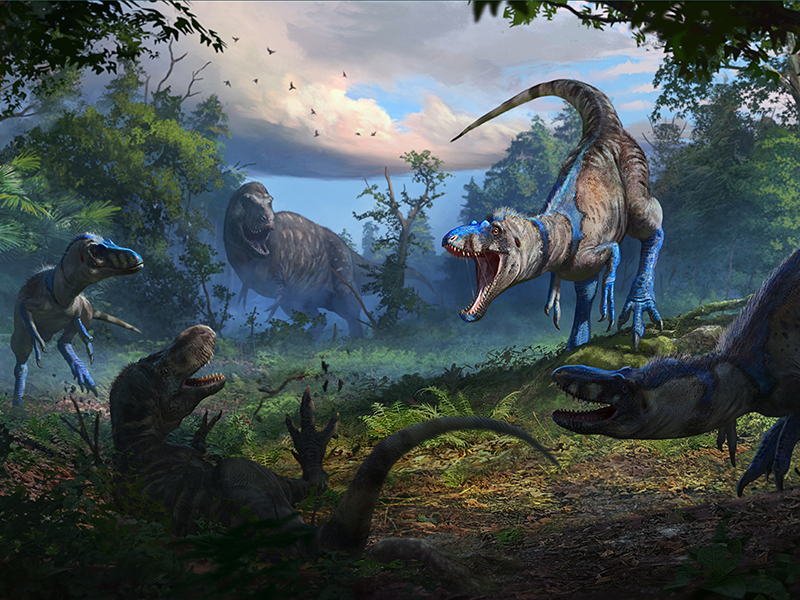
After many years of misinformation and confusion,vertebrate paleontologist, and researcher in the Department of Anatomical Sciences at the Renaissance School of Medicine (RSOM) James Napoli, along with the head of paleontology at the North Carolina Museum of Natural Sciences Dr. Lindsay Zanno, has made the astonishing distinction between the Tyrannosaurs and Nanotyrannus. Since the 1940s, paleontologists had believed that the Nanotyrannus lancensis fossils were juvenile Tyrannosaurs, rather than their own species. However, today we have recently learned that that is false.
After careful analysis, Napoli and Zanno have realized they are far from being the same dinosaur. The Nanotyrannus’ bone structure has larger hands, fewer tail vertebrae and more teeth when compared to the well-known Tyrannosaurus.
“The Nanotyrannus had very long arms with a vestigial third finger, not short two-finger arms like the T. rex,” Napoli said. “[They also have] different skull nerve and sinus patterns, which makes the Nanotyrannosaurus biologically unable to be a T. Rex.”
The Nanotrynnosaurus was first discovered in Georgia. It was found in combat with a Triceratops and also had seemed to be 20 years of age at the time of its final battle.
Both Napoli and Zanno have examined over 200 Tyrannosaurus fossils. They not only distinguished between the two but also discovered a new species within the Nynotyrannosaurus species; the Nanotyrannus Iethaeus which, in theory, would be a bit smaller than the Nanotyrannus lancensis.
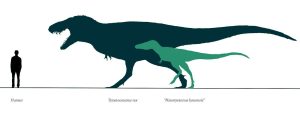
The Nanotyrannus is also known as the N. lethaeus, named after the River Lethe from Greek Mythology, referencing it being forgotten and hidden away for decades.
With new things coming out about the times before humans roamed the world, it brought interest to the field. All the way from fascinated adults to many children, creating wonder and interest in the fields and employment. With more and more discoveries being made everyday the youth is very interested.
Four-year-old dinosaur enthusiast Mossiella Acosta Mendoza was pleasantly surprised by the discovery and is so excited to learn much more about dinosaurs.
“That’s so cool [that[ the T. Rex and [ Nanotyrannus ] are dinosaurs, and [that] they are like sis[ters],“ Acosta Mendoza said.
This makes a critical difference in prehistoric times as for well over 80 years, the studies made on the Tyrannosaurs have been formed as a whole combination of two different species, leaving paleontologists to have to redefine not only the Tyrannosaurs species itself but also the whole of the ecosystem that once existed.