






































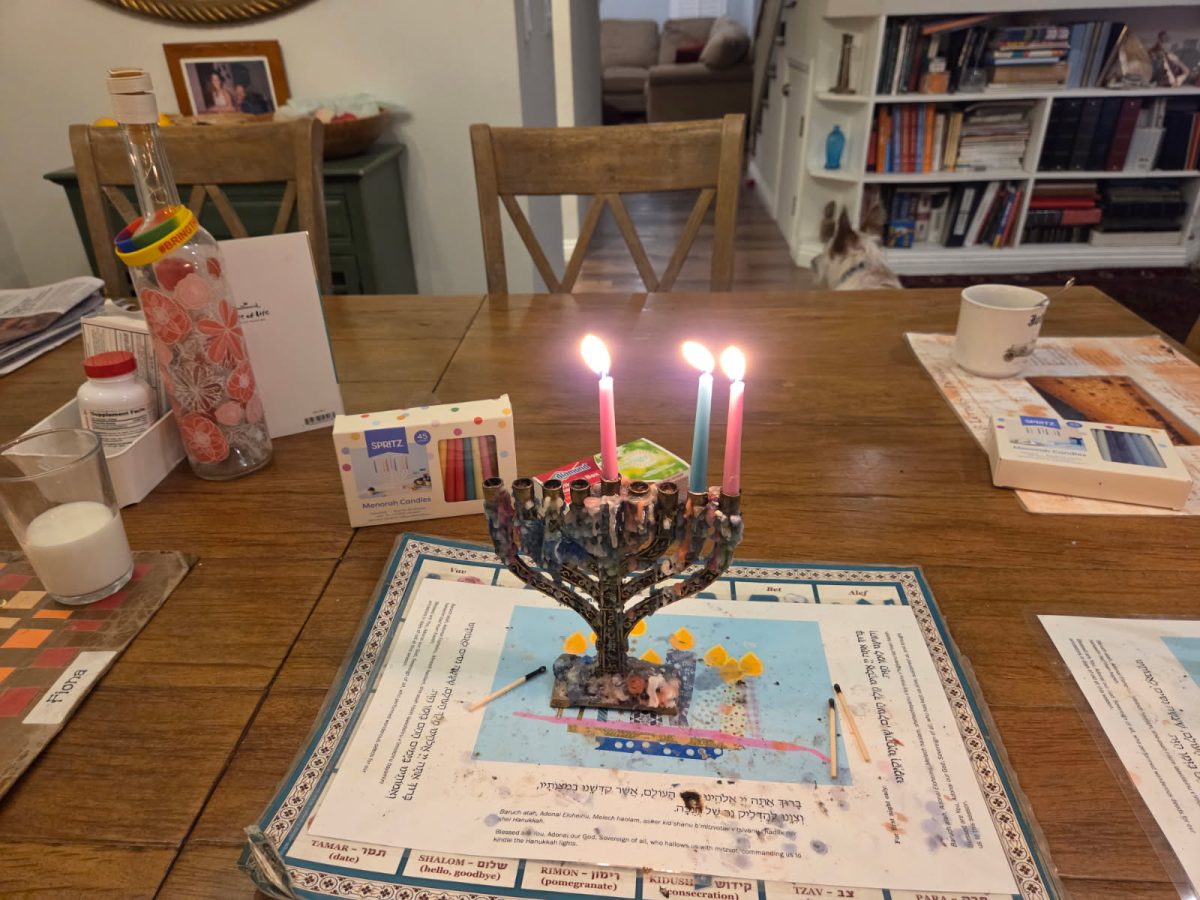
As the holidays commence, red and green decorations take over the stores, candles brightly light the windows and the festive spirit is present in each and every person.
Through all this Christmas cheer is the often overlooked Jewish holiday of Hanukkah, cast in the shadow of the birth of Jesus.
Long known incorrectly as the “Jewish Christmas” to many, the story of Hanukkah speaks of perseverance, grit and survival, facing against foes and coming home victorious.
The story takes place in ancient Israel, ruled by the Hellenistic Greek king, Antiochus, a tyrant to many. Antiochus wanted everyone in his kingdom to practice the Greek religion. To the Jews living in the land, this came as a direct threat. When they refused, Antiochus sent armies to destroy the Holy Temple in Jerusalem and drive the Jews out.
From this turbulent time in history, arose the heroic group of Jewish Zealots, a ragtag group of Jews led by Judah Macabee, determined to fight back against the tyrant and reclaim their temple.
The Greeks had an army of trained troops, elephants and years of experience. The Maccabees had nothing; yet they persisted, and after years of fighting, the Greeks finally retreated, relinquishing their religious control to the Jews.
When the Jews returned to the temple, they found it desecrated.Windows were smashed, Torahs were ripped and even their sacred menorah lay in ruin. They were able to fix the menorah; however, they only had one jar of oil left to light it – A jar of oil that couldn’t possibly last for eight whole days.
Miraculously, however, it did, which is the miracle of Hanukkah Jews worldwide celebrate today.
That, at least, is the rabbis’ interpretation.
“The rabbis’ were the ones who brought the story of the oil,” director of Education and Operations at Temple Beth Torah, Dr. Cliff Wilcox said, “Religion wasn’t [originally] part of the Hanukkah story. It had to be brought in.”
Commercialism has also played a huge role in blurring the holidays together. Even religious Christians see the effects of this, as Christmas is played off as a gift giving holiday, rather than one of the holiest days of the year for them.
“It’s the birth of a person that Christians consider to be their Savior. That’s incredibly sacred, and I feel bad for my minister friends who have to fight against the commercialism and the secularism of Christmas,” Rabbi Lisa Hochberg-Miller said.
Christmas and Hanukkah weren’t always the commercial giants they are today. Following the WWII, when the economy boosted, families started indulging in presents to celebrate the holidays.
“After WWII, when families had more money to spend on presents and decorations, which wasn’t something people had spent money on before, those holidays were acknowledged,” Hochberg- Miller said. “People started to get really materialistic about Christmas and Jews started to have more money and start[ed] to buy gifts as well.”
During Hanukkah, many American families exchange gifts throughout the holiday, which lasts for eight consecutive nights. While the holiday usually takes place in December, it follows the Jewish calendar, which is different from the Gregorian one, making Hanukkah sometimes overlap with Thanksgiving and sometimes Christmas, depending on the year.
“December’s a really great month to teach about religious diversity,” Hochberg-Miller said. “We’re just in a more conservative environment these days, and people are less concerned about being inclusive.”
Even today, as Jews worldwide grieve the victims of the terrorist attack in Bondi beach, Australia, where victims range from a ten-year-old girl to a Holocaust survivor, we remember the Hanukkah story and the values it instills in us. We will survive this. We’ll endure it. And we will dance again.